Description
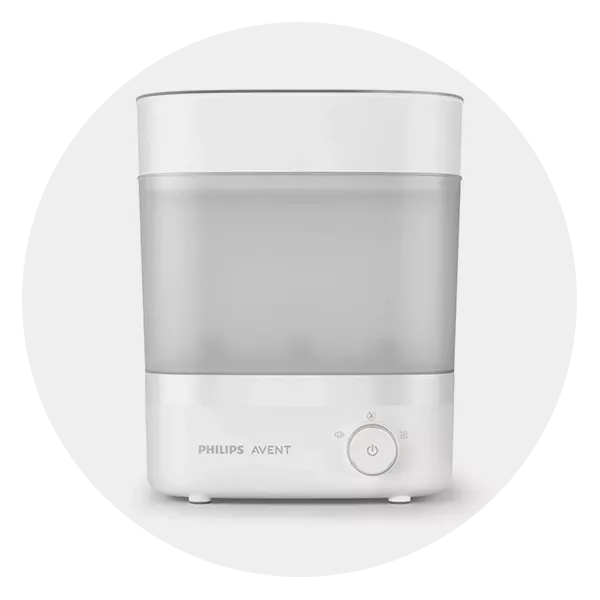
The beauty of the Philips Avent Baby Bottle Sterilizer & Dryer Premium lies in its simplicity—no buttons, no confusing settings, just three straightforward and effective cycles all operated by a single dial. As a parent who’s easily [overstimulated](https://www.thebump.com/a/reasons-parents-overstimulated) these days, I can’t tell you how much I appreciate a baby appliance without a steep learning curve. It sanitizes *and* dries in just 40 minutes, or you can choose a quick 10-minute sterilize or 30-minute dry-only cycle. The only feature I wish it included? A countdown display to let me know exactly how much time remains. Aside from its easy to use interface, the Avent sterilizer won me over with its generous capacity. Before I loaded up the sterilizer, I cleaned all of the items with soap and water following the advice of [Jenelle Ferry](https://www.pediatrix.com/find-care/doctors/ferry-jenelle-1619168648), MD, a board-certified neonatologist, pediatrician and director of feeding, nutrition and infant development at Pediatrix Medical Group, who said that when sterilizing, parents should “be sure to include /[the] bottle brushes you’re using to wash them.” I’m happy to report that I was able to easily fit my [baby bottle cleaning brush](https://www.thebump.com/a/baby-bottle-brushes) into the large Avent basin, something I couldn’t do with many other sterilizers. While the manual shows it’s designed for six bottles, I loaded eight (both wide and narrow-mouth) without overcrowding. It also comes with a separate tray I used to sanitize everything from bottle nipples and teethers to baby spoons and pacifiers. With the accessory tray removed, tall 9-ounce bottles (like those from Dr. Brown’s) fit too. Despite its large capacity, I find its footprint to be modest, which is a plus for families with limited counter-space. %% IMAGE 1 %% While the sterilization cycle takes a minute longer than two other units I tested, I like that it uses tap water rather than distilled. (This device uses 4.5 ounces of water per sterilizing cycle, so if it were to require distilled water the costs would add up over time.) The manual doesn’t mention a cool-down period, but I recommend waiting 5 to 10 minutes after the cycle finishes before unloading it, as the baskets and items become very hot and a lot of steam is released. Alternatively, you can leave the lid on and the bottles will stay sterile for up to 24 hours. The dry cycle was efficient and effective. However, skipping the dry cycle left standing water in the bottom of the unit. Removing the bottle compartment before the heating plate cools completely also caused the water to sizzle and leave brown spots on the plate. Fortunately, the plate wiped clean with a soft towel, and I didn’t come across reports of long-term mechanical issues. Still, the included two-year warranty is a nice reassurance. Like most new parents I value peace and quiet, so I used an app on my phone to measure the sound level emitted by each electric sterilizer, specifically during the wash and dry cycles, which can be noisy. The Philips Avent Baby Bottle Sterilizer generated 49.5 decibels of sound during dry-only mode, which was a little loud, but wasn’t enough to put me off using it again. Overall, I liked the large capacity and simplicity of the unit, making it my top choice. **Dimensions:** 12" (L) x 7.5" (W) x 14.9" (H) | **Capacity:** 6 bottles | **Sterilize cycle duration:** 10 minutes | **Dry cycle duration:** 30 minutes %% TESTIMONIAL 1 %%