



























Best Pregnancy Stretches for Your Back, Hips and More


We absolutely understand the impulse to turn into a couch potato during pregnancy, binge-watching all the shows and eating all the ice cream. And, of course, you have the perfect reason to do this a lot more than you normally would. But—hear us out here—there are plenty of benefits to gentle movement such as stretches during pregnancy.
“Preparing for labor involves both physical and emotional readiness," says Ella Speichinger, MD, an ob-gyn at University of Missouri Health Care, adding that stretching is the perfect way to tackle both since it can help with those all-too-common pregnancy aches and pains while promoting mindfulness and managing stress.
Melody M., mom of two in Texas, confirms that stretching has dual benefits: “It helped with basic comfort—aches, hip pain, tightness—but also gave me a way to stay mobile and mentally steady as I focused on prepping my body for birth. It helped me feel like I was doing something to support what was coming.”
If you’re interested in trying some pregnancy stretches, check out expert-recommended moves for your hips, lower back and more, ahead—plus, what to skip and how to make sure you’re moving safely through all your prenatal stretches.
- Regular pregnancy stretches can help relieve pain and tightness, increase your circulation, improve your posture, open up more space for baby and help you prepare for labor.
- Pregnancy stretches recommended by experts include cat-cow, seated hamstring stretch, child’s pose, happy baby and others.
- It’s best to focus on prenatal stretches that work your hips, pelvis and lower back—but don’t neglect your chest, shoulders and legs either.
- Avoid lying on your back for too long, especially after 20 weeks of pregnancy, and utilize basic yoga supplies like stability balls for extra support.
Here are the best stretches for pregnant women to help you feel your best, according to experts.
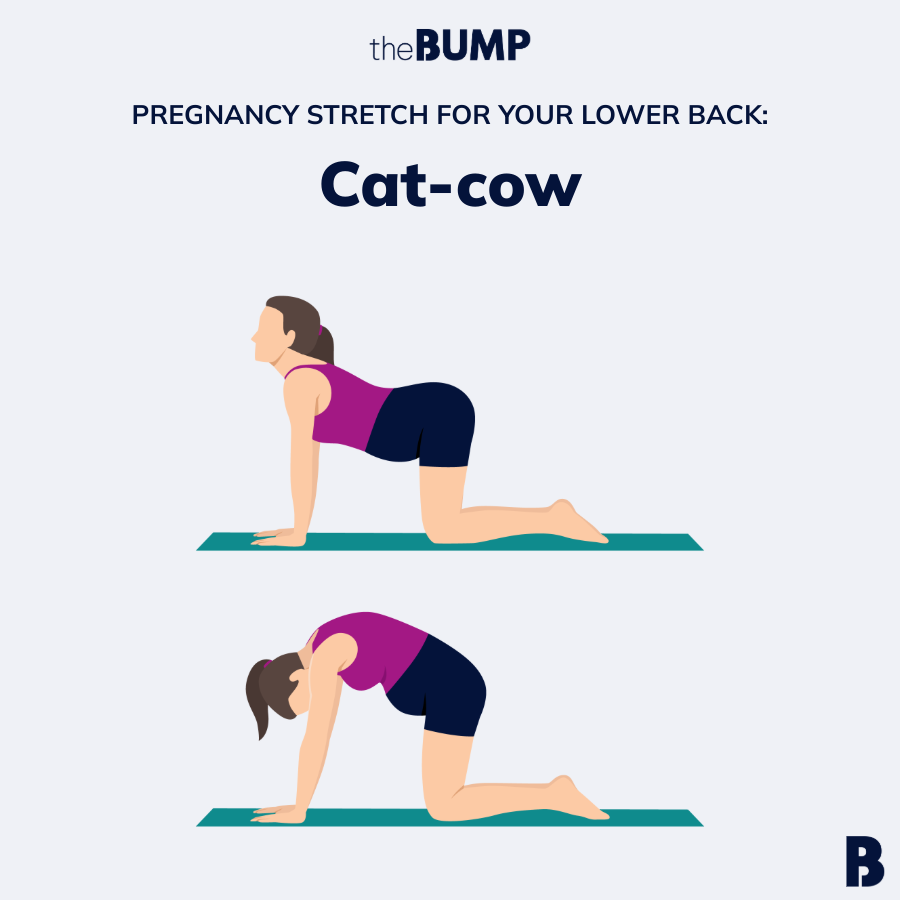
For your lower back: Cat-cow
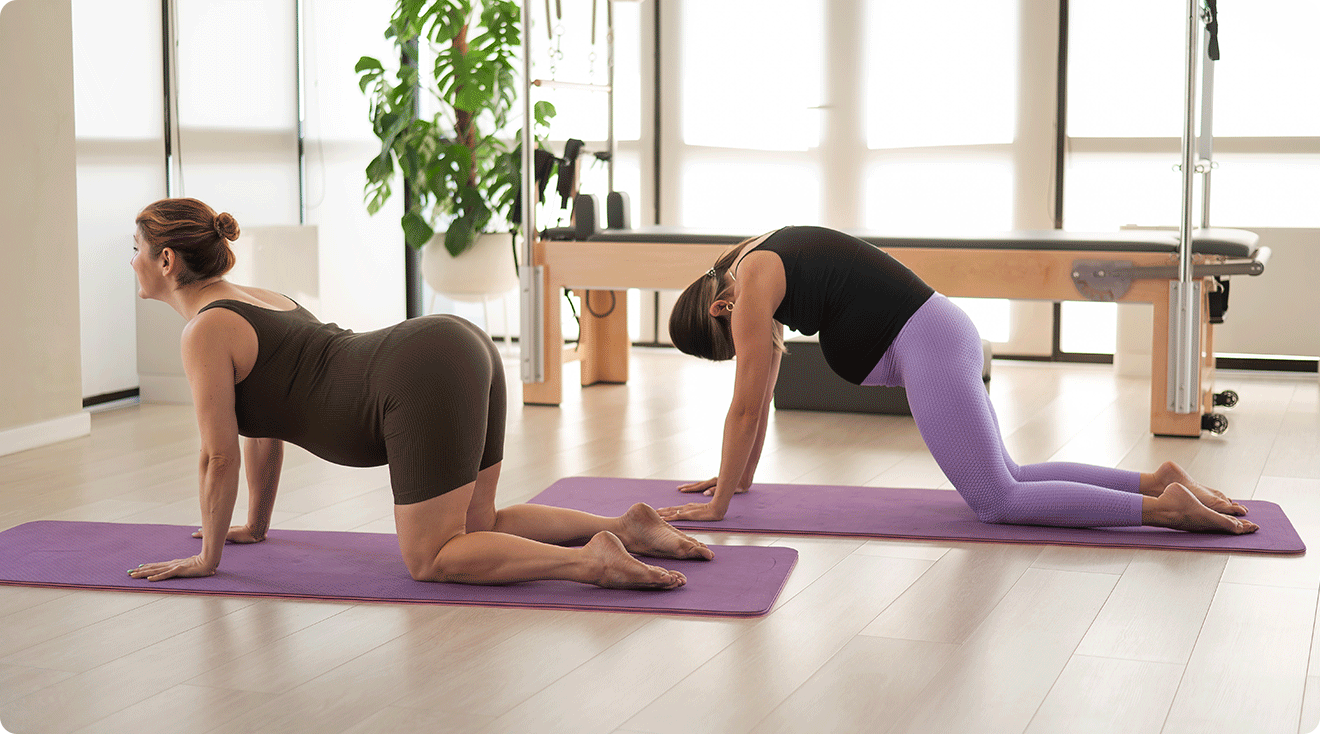
This stretch increases flexibility in your spine, helping to relieve lower back pain, says Speichinger. Get on all fours with your hands shoulder-width apart and your knees directly under your hips. As you inhale, lift your sitz bones (aka those bones on the bottom of your pelvis that you sit on) up toward the ceiling, allowing your head to lift up and your belly to drop. This is “cow.” Then exhale while arching your spine, lowering your head and tucking in your tailbone. This is “cat.”
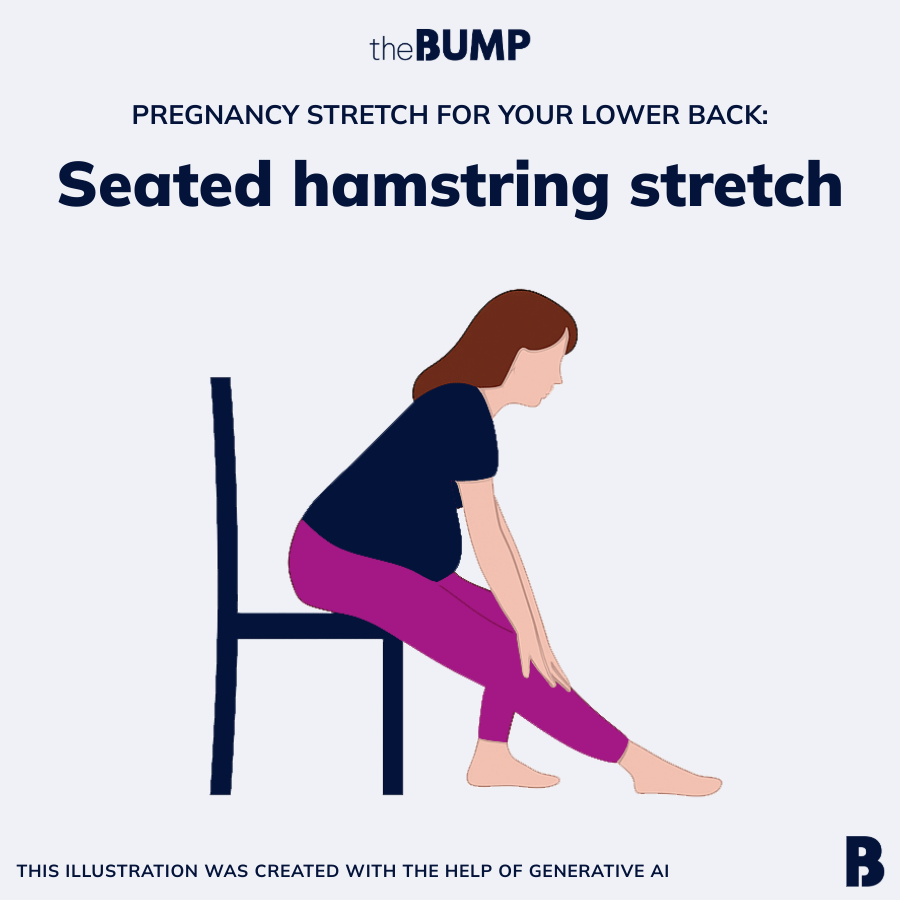
For your lower back: Seated hamstring stretch
Tight hamstring muscles can contribute to lower back pain. Speichinger suggests doing a seated hamstring stretch, but advises not leaning too far forward and squishing your abdomen. Sit in a chair with one leg extended, resting on your heel, and the other bent normally in front of you. Bend gently at your hips, hold the stretch while you breathe, then return to the start position before switching legs.
For your back and hips: Child’s pose
To gently stretch your back and hips, try a pregnancy-friendly child’s pose. Kneel on the floor, then sit back on your legs with your bottom resting on your heels. Slowly spread your knees wide enough to accommodate your belly. Lean forward onto your elbows and hold the stretch, or—if you can—extend your arms all the way out in front of you and rest with your chest on the floor. You can also lean on a stability ball, if needed, instead of lowering down to the floor.

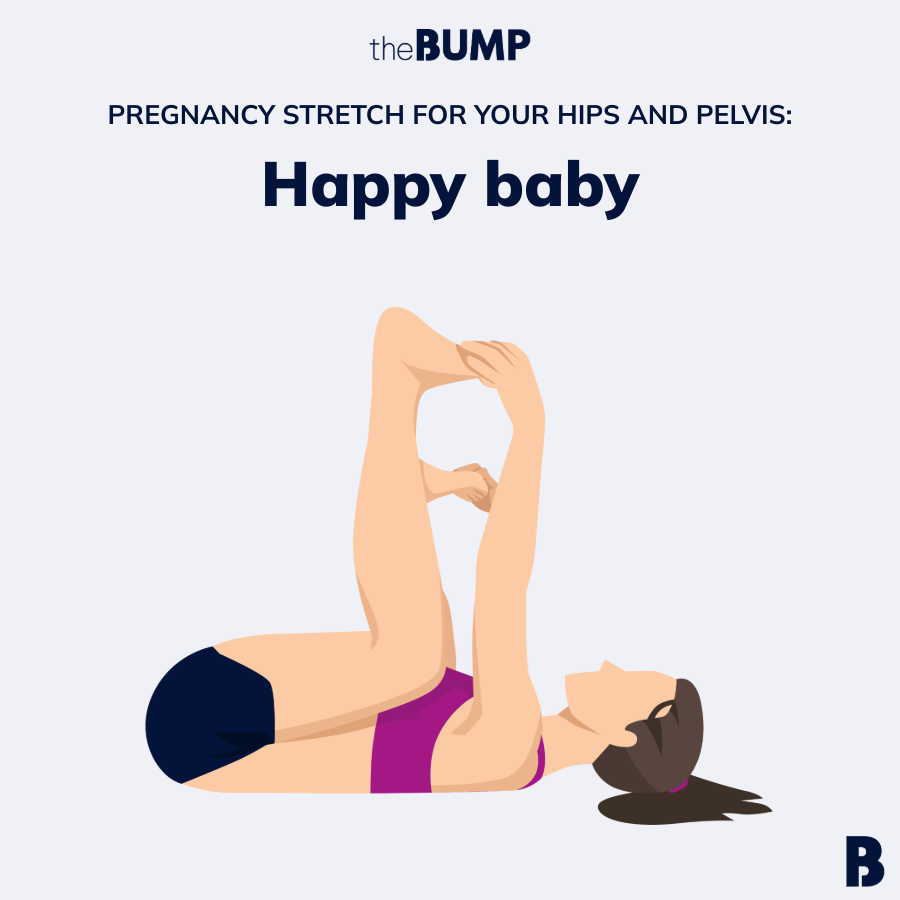
For your hips and pelvis: Happy baby
Speichinger says this hip-opening posture gently stretches the inner thighs, groin and lower back, improving pelvic floor and hip flexibility. Before 20 weeks, you can perform the stretch normally (on your back), but after 20 weeks switch to doing it on your side to avoid prolonged time on your back.
Lie on your back (or side) and pull your knees up toward your chest. Grab your feet or ankles with your hands and move your legs apart slowly until you feel a gentle stretch in your inner thighs. Hold the stretch while you breathe, then gently release back to your starting position.
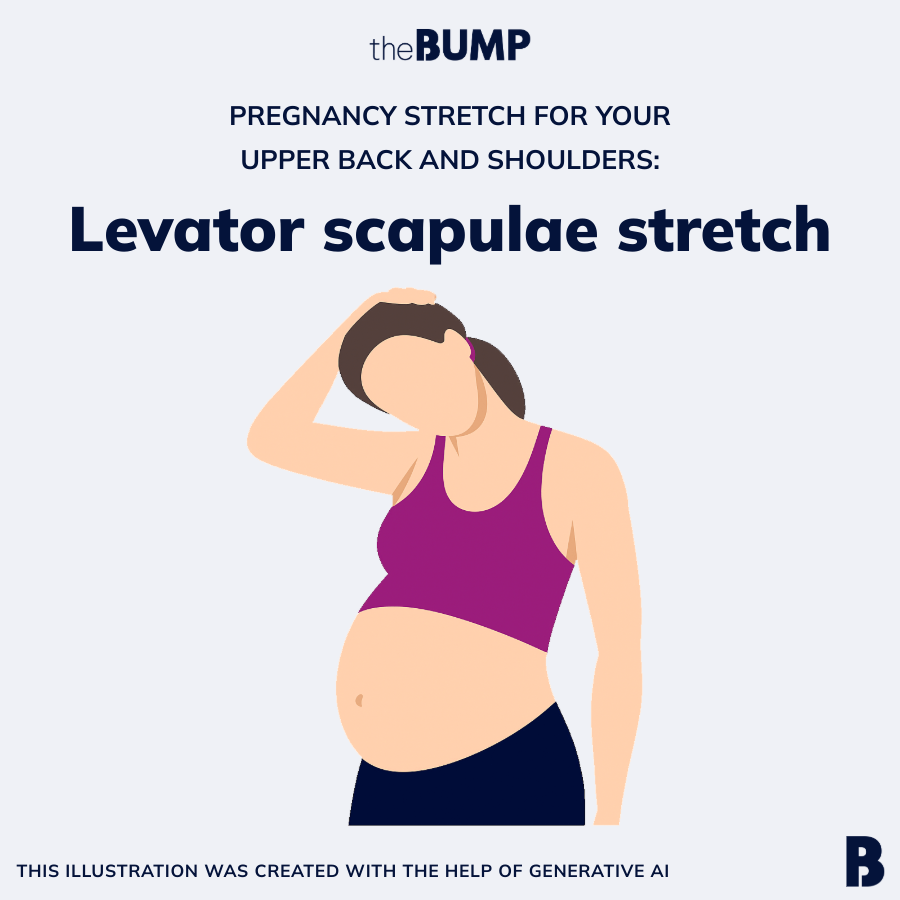
For your upper back and shoulders: Levator scapulae stretch
As your center of gravity shifts, it pulls down your posture, explains Meredith Witte, an exercise physiologist and certified prenatal and postnatal yoga instructor, noting that stretching your upper back and shoulders can help promote a more upright posture. Speichinger recommends a levator scapulae stretch: Simply rotate your head about 45 degrees to one side, then gently flex the neck forward—pointing your chin toward your armpit—and hold the stretch for 15 to 30 seconds. Use your opposite hand to guide your head down into position, if needed.
For your hips: Hip rocks or circles
Hip mobility drills open up space for baby to descend into your pelvis in the third trimester, plus create extra stability for a stronger pelvic floor, says Witte. Two common hip mobility drills are hip rocks and hip circles.
- For hip rocks: Get into table pose (all fours with a flat back), but spread your knees slightly wider than hip-width; keeping your back flat, move your tailbone back toward your heels, as if you were going to sit on them, but then return to the start position. This creates a rocking movement. (It’s also sort of like doing a squat, but on all fours.)
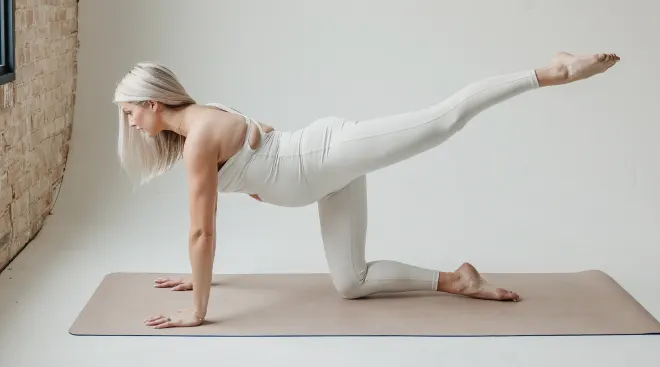
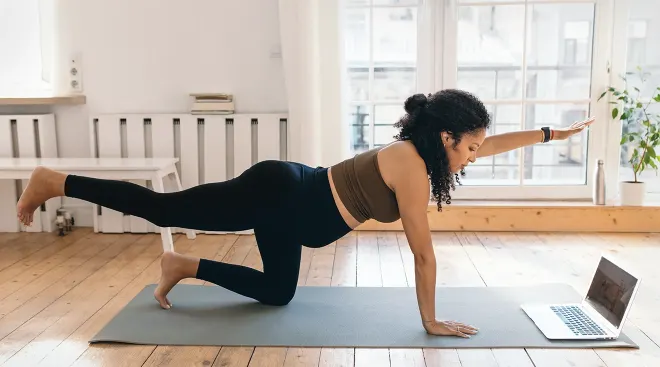
- For hip circles: Get into table pose, but keep your spine flat; lift one leg off the ground and move it front to back in a circular motion. You can repeat the circle 5 to 10 times before switching legs.

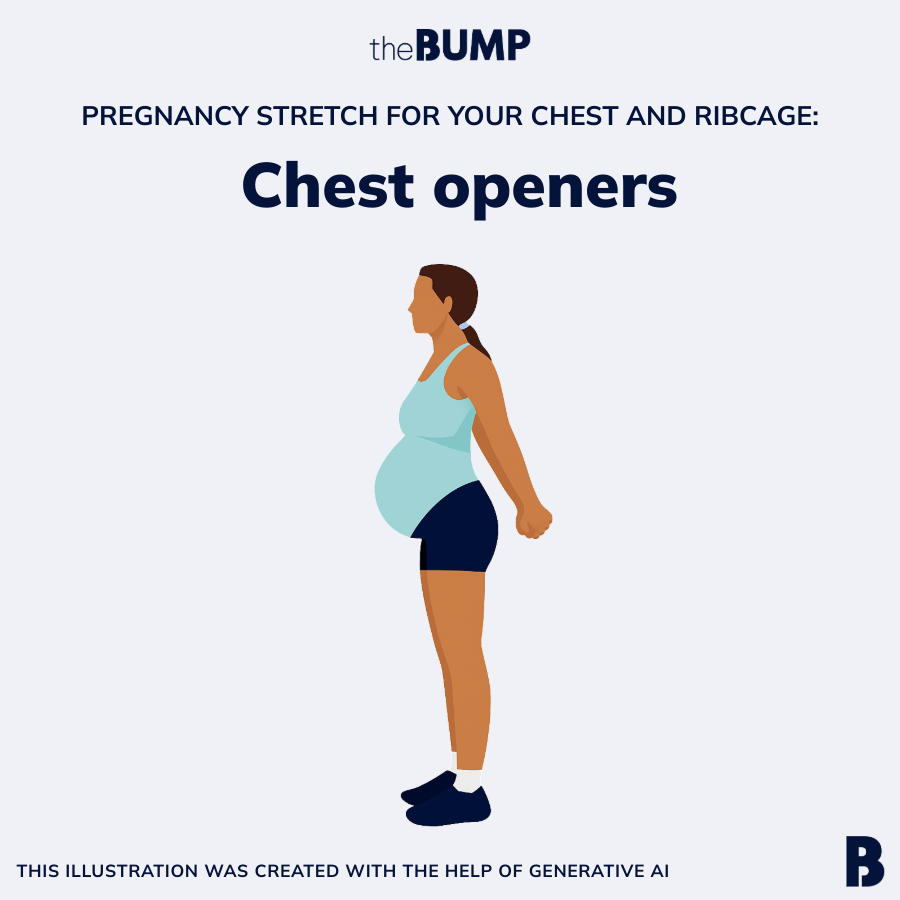
For your chest and ribcage: Chest openers
Eventually, baby’s going to get big enough to reduce the amount of space in your chest. It’s important to stretch your ribcage and practice your breathwork so you’re not constantly huffing and puffing, says Witte.
There are several types of chest-opening stretches you can do:
- Place your forearms on either side of a wall corner and lean forward into the empty space.
- Lie on one side, with the arm on the floor extended out in front of you; with your other arm, stretch up and back behind your body.
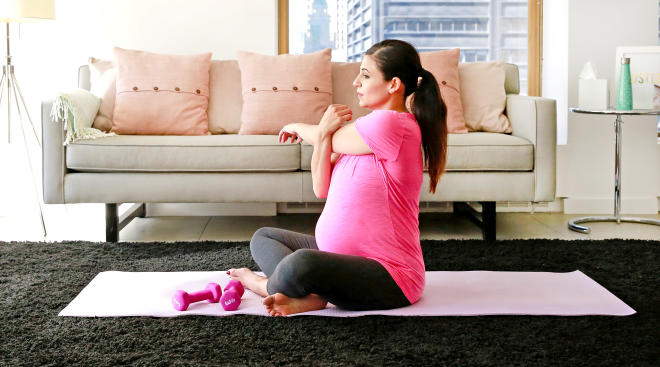
- Sit in a chair, clasp your hands behind your back, straighten gently at the elbows, then raise your arms up slightly.
Katherine W., mom of one in Colorado, says that during pregnancy, she found herself constantly hooking her arms around one side of a doorway and leaning forward into a deep stretch: “[This was] particularly helpful in combating the increasing neck and shoulder tension that crept in as the size and weight of my belly and breasts continually increased.”
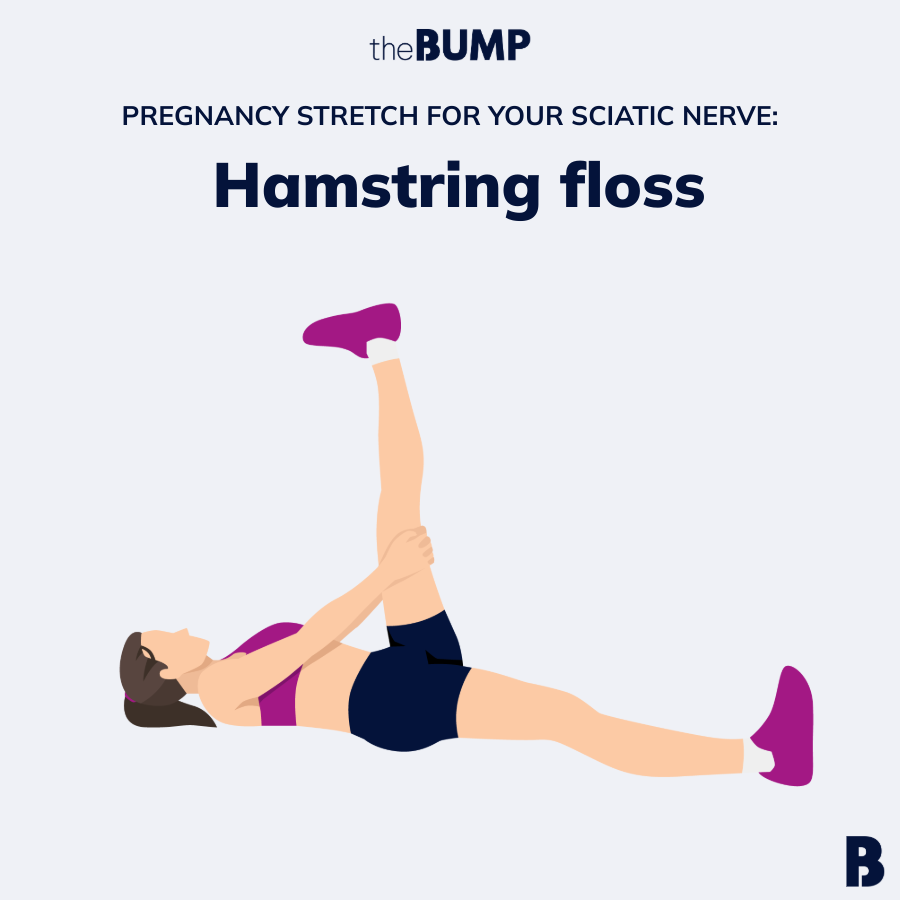
For your sciatic nerve: Hamstring floss
Stretching your hamstrings can help mobilize the sciatic nerve, decreasing pain and tightness along the backs of your legs, says Witte. Lie on your back with both legs bent at the knee and toes pointed out. Gently extend one leg up, stopping as soon as you feel muscle tension. (Tip: Place your hands around the back of your thigh for support.) At the top of the stretch, flex your foot so it’s no longer pointed out but flat. Then return to the start position and either repeat or switch legs. Don’t overstretch here: That could make your nerve discomfort worse.
There are plenty of both physical and emotional benefits to doing pregnancy stretches:
- They reduce pain and tension caused by body alignment changes as your center of gravity shifts, says Emily Claman, a certified prenatal and postnatal trainer and founder of Push Fitness.
- They may help you maintain a healthy blood pressure: a 2015 study found stretching to be as effective as walking in lowering blood pressure, while a 2010 study found stretching to be potentially protective against preeclampsia.
- Regular prenatal stretches improve circulation, says Claman, which helps decrease pregnancy-related swelling.
- Pregnancy stretches help improve your range of motion, reducing the chances of injury with normal, daily activities. They also make your core and back muscles stronger, helping you maintain a more comfortable posture.
- They increase mobility and flexibility in the pelvis, creating more space for baby to get into an optimal fetal position before labor, Claman says.
- They help promote a strong mind-body connection, which can relieve stress during pregnancy and set you up for a shorter, calmer labor.
You don’t need to spend a lot of time stretching during pregnancy—even a few minutes each day working on problem areas or rotating through a circuit of stretches can provide benefits in each trimester and during labor. “I started stretching in my second trimester, when I got more uncomfortable, and continued through my third trimester,” says Carrie M., a doula and mom of two in Texas, who experienced sciatica and general aches and pains during her pregnancy. “I didn’t stretch every single day, but I tried to stretch as much as I could because my body felt so much better when I spent a little time on it.”
According to Speichinger, there are only a few types of stretches you should limit or avoid during pregnancy, including:
- Repetitive twisting motions, which can decrease oxygen flow to the uterus
- Prolonged exercises on your back, which can compress the large blood vessels in the abdomen and cause dizziness and decreased blood flow to the uterus
- Any exercises that could throw off your center of gravity or increase your risk of falling
Stretching is generally safe during all three trimesters, says Marsha Granese, MD, an ob-gyn at Providence Mission Hospital in California. If you have an existing injury, though, she recommends checking with your healthcare provider or getting a consultation from a physical therapist so you can get help modifying stretches to fit your body’s needs.
If you’re worried about being in a supine position for too long, many common stretches can be done while sitting in a chair or in a reclined position rather than flat on your back, says Granese. You can also use a chair to avoid standing for a prolonged period of time, especially if you’re concerned about losing your balance. Finally, don’t overlook other basic tools that can make stretching with a bump more comfortable: Melody and Katherine both said they relied heavily on a stability ball to support them during hip, pelvic and back stretches.
Frequently Asked Questions
Can you stretch your stomach during pregnancy?
There are benefits to keeping your stomach strong and flexible during pregnancy, says Claman, but you want to make sure you’re stretching this area gently and intentionally. It’s already experiencing high amounts of tension and pressure, she says, so you shouldn’t overstretch it.
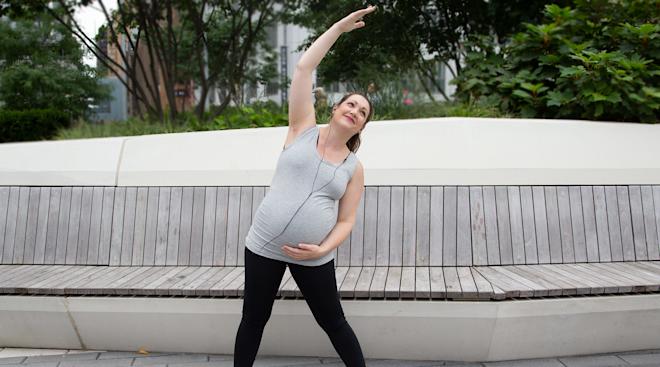
Instead, try cat-cow stretches and seated or standing side bends to keep these muscles open and lengthened—and always pair stomach stretches with deep core breathing, adds Claman, to make sure you’re engaging the right muscle groups (like your diaphragm and pelvic floor).
When can you start prenatal stretching?
It’s never too early! Granese says if you really want to get ahead, work on becoming more flexible and strong through stretching even before you get pregnant. But if you’re already pregnant, you can start stretching at any time.
Is prenatal stretching the same as prenatal yoga?
Witte defines prenatal stretching as any type of stretching done while pregnant, and says that although a lot of prenatal stretching is involved in prenatal yoga, they’re not the same thing. Prenatal yoga also involves other components, like mindfulness to help you manage your emotions during pregnancy and labor, and traditional yoga postures (like tree pose), which are great for building stability and calming the mind but aren’t necessarily stretches.
Is pregnancy stretching safe in the first trimester?
Yes, you can safely start stretching in the first trimester to alleviate any early aches and pains, or establish a stretching routine that could be helpful as you get further along in your pregnancy.
Is pregnancy stretching safe in the third trimester?
Yes, but you should be mindful of your positioning in the third trimester. It’s best to avoid lying on your back for long periods of time, and you may need to have something to hold onto during standing stretches if your belly is throwing off your balance.
What’s the best stretch for pregnancy sciatica pain?
According to Witte, there are a few sciatica pregnancy stretches you can do to relieve sciatica pain, including:
- Cat-cow or pelvic tilts on all fours
- Hamstring flossing
- Any stretch where your thigh is rotated outward to release tension
However, she also warns that stretching isn’t always the ideal approach for sciatica: “Stretching can often be a bit too intense as an aid for sciatic nerve pain—I find gentle mobilization and activation of the muscles around the pelvis to be [better].”
Pregnancy stretches can relieve muscle pain and tension, improve circulation, increase range of motion, manage stress and help you prepare for labor. Any stretches that work your back, hips, legs, shoulders and neck can be beneficial, but make sure you’re being mindful of your positioning, especially during the third trimester when it’s important to stay off your back for long periods of time. If you have any questions about the safety of prenatal stretches or need advice on modifying your moves, talk to your healthcare provider or a physical therapist.
Please note: The Bump and the materials and information it contains are not intended to, and do not constitute, medical or other health advice or diagnosis and should not be used as such. You should always consult with a qualified physician or health professional about your specific circumstances.
Plus, more from The Bump:
Emily Claman is a certified prenatal and postnatal trainer and the founder of Push Fitness.
Marsha Granese, MD, is an ob-gyn at Providence Mission Hospital in California. She earned her medical degree from St. George’s University School of Medicine.
Ella Speichinger, MD, is an ob-gyn at University of Missouri Health Care. She earned her medical degree from the David Geffen School of Medicine at UCLA.
Meredith Witte is an exercise physiologist and certified prenatal and postnatal yoga instructor. She’s the founder and head instructor of The Playground.
Iranian Journal of Nursing and Midwifery Research, The Effect of Stretching Exercise and Walking on Changes of Blood Pressure in Nulliparous Women, March-April 2015
Journal of Nursing, Prenatal Stretching Exercise and Autonomic Responses: Preliminary Data and a Model for Reducing Preeclampsia, June 2010
Nemours KidsHealth, Why Do Many Pregnant Women Pull Ligaments, Muscles, and Joints?, January 2021
Taiwanese Journal of Obstetrics and Gynecology, The Wonders of Mind-Body Practices during Pregnancy: A Topical Review, July 2024
Real-parent perspectives:
- Carrie M., doula and mom of two in Texas
- Katherine W., mom of one in Colorado
- Melody M., mom of two in Texas
Learn how we ensure the accuracy of our content through our editorial and medical review process.
Target Baby Registry
Free $100+ Value Welcome KitFree $100+ Value Welcome Kit
15% Completion Discount15% Completion Discount
Free 1-Year ReturnsFree 1-Year Returns
20+ Exclusive 20% Off
Deals For Mom & Baby20+ Exclusive 20% Off Deals For Mom & Baby1:1 Concierge With
Baby Gear Specialists1:1 Concierge With Baby Gear Specialists

*Subject to availability and Retailer's terms.
We earn commissions from these links.