





Sleep Guidelines for Babies And Parents


Okay, new parents, we know it’s not exactly possible to stick to a sleep routine or, who are we kidding, getting actual sleep. But the National Sleep Foundation has released recommendations that should serve as a rule of thumb for getting some shut-eye, breaking down the guidelines by age group. And surprise—not all sleep is created equal.
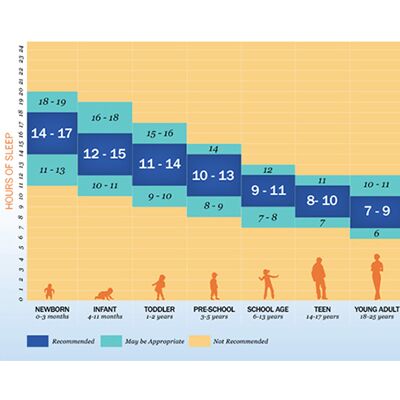
In order to function like a normal human being (you know, give the milk bottle to baby, not the dog), you need to fulfill your individual basal sleep need. That will vary from person to person. But things get tricky if you’re accumulating sleep debt—sleep that’s lost over time to poor sleep habits, sickness or awakenings. Even if you’re getting enough basal sleep, sleep debt could leave you feeling extremely sleepy or less alert at different times throughout the day. And if you’re sleep-deprived and reading this, the National Sleep Foundation’s easy-to-digest chart above should help clear up just how little sleep you’re getting and how much sleep baby should be getting.
Here’s how much sleep different age groups need:
Adults (18-64 years)
7-9 Hours
Why it matters: Researcher Kristen L. Knutson, Ph.D., says short sleep durations of 4-5 hours have negative physiological and neurobehavioral consequences. For your sake—and baby’s—you need to try and log some ZZZ’s.
Newborns (0-3 months)
15-17 hours
It’s okay for newborns to have irregular sleep habits, breaking up these 15 to 17 hours with up to three hours of awake time. And you can expect them to sleep actively, sometimes twitching, smiling or sucking.
Infants (4-11 months)
12-15 hours
This is when a routine becomes more important. Most infants (70 to 80 percent) will sleep through the night by 9 months, logging somewhere between nine and 12 hours. Multiple naps—from 30 minutes to two hours—are recommended throughout the day.
Toddlers (1-2 years)
11-14 hours
Is your toddler resisting going to bed? Make sure her nap—now down to one per day—isn’t too close to bedtime. A new drive for independence and better cognitive and social skills makes toddlers reluctant to get under the covers, but enforcing a routine should help.
Please note: The Bump and the materials and information it contains are not intended to, and do not constitute, medical or other health advice or diagnosis and should not be used as such. You should always consult with a qualified physician or health professional about your specific circumstances.
Target Baby Registry
Free $100+ Value Welcome KitFree $100+ Value Welcome Kit
15% Completion Discount15% Completion Discount
Free 1-Year ReturnsFree 1-Year Returns
20+ Exclusive 20% Off
Deals For Mom & Baby20+ Exclusive 20% Off Deals For Mom & Baby1:1 Concierge With
Baby Gear Specialists1:1 Concierge With Baby Gear Specialists

*Subject to availability and Retailer's terms.
We earn commissions from these links.


