






























Baby Feeding Chart: How Much Should a Newborn Eat?



If you find yourself fretting over your newborn’s feeding schedule, you’re not alone. Bringing home a baby and trying to make sure that they’re getting enough (but not too much) to eat can feel impossible.
With my first daughter, I tried pumping but produced very little, leaving me to supplement with formula and stressing over finding the right balance.
My second daughter was a NICU baby who needed to gain weight in order to come home‚ but she was tiny and there was only so much she could eat in a day.
“For a normal, healthy newborn, feeding on demand is ideal,” says Jaimie Zaki, LPN, IBCLC, a lactation consultant, birth doula and founder of Little Bear Lactation in Tuscola, Texas. “Whether formula or breastfeeding, it’s very important to understand that during the early days of life, baby’s stomach is extremely tiny, and has a capacity of only 7 to 9 milliliters the first day of life, slowly increasing each day.”
So how much should a newborn eat? How about a growing infant? Read on to dig deeper into newborns’ eating habits—and check out our handy baby feeding chart.
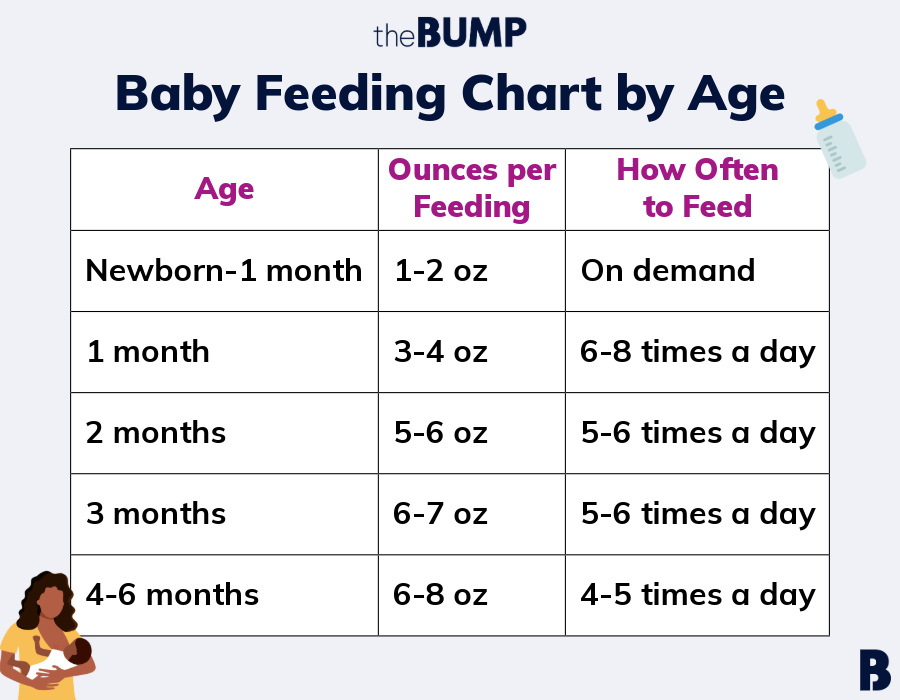
- Newborns have very small stomachs and will eat around 1 to 2 ounces per feeding for the first few days of their lives. Once they reach 1 month old, they’ll typically eat around 3 to 4 ounces per feeding.
- By the time they reach 6 months old, babies will typically eat 6 to 8 ounces per feeding, four or five times a day.
- Learning baby’s hunger and fullness cues will help you ensure you’re not over- or under-feeding them.
- Your pediatrician will closely monitor baby’s growth and weight, which will be a key indicator of whether they’re eating too much or not enough.
If you’re wondering how much a newborn should eat by age, we have it laid out for you. Typically, the more baby grows, the more they’ll need to eat. While every baby’s growth and development is unique, your pediatrician will monitor their weight gain and growth using a growth chart and ensure they’re eating the right amount for their age and size. Check out our baby feeding chart by age for both breast milk and formula to see what you can expect during different stages.
Newborn
In the first week after birth, newborns typically eat no more than 1 to 2 ounces per feeding. The feeding schedule can be a bit erratic—particularly for breastfeeding parents, since baby will often want lots of small “meals” around the clock.
1 to 3 months
During their first month, baby will gradually start to eat more per feeding—up to around 3 to 4 ounces—and averaging around 32 ounces a day. By the end of the first month, both breastfed and formula-fed babies eat about every three to four hours (aka six to eight times a day).
At 2 months old, you can expect baby to eat 5 to 6 ounces per feeding, around five to six times per day.
By 3 months old, baby eats 6 to 7 ounces per feeding, around five to six times a day.
4 to 6 months
When baby’s around 4 to 6 months old, you can start introducing solid foods into their diet. Keep in mind, though, that this is mostly to expose them to different tastes and textures—baby’s primary source of nutrition should still be breast milk or formula.
By the time they reach 6 months old, you can expect baby to eat 6 to 8 ounces per feeding, four or five times per day.
How much should a newborn eat per feeding and each day? During their first few days on the planet, baby’s still trying to get the hang of eating, so expect a more erratic newborn feeding schedule. “The most important thing to remember about feeding a newborn is that, within broad guidelines, you follow baby’s signals about how much is enough,” advises Dr. Laura Steelman, MD, a pediatrician with Bluebird Kids Health in Jacksonville, Florida.
Breastfeeding may be tricky at first—it’s a new skill for you and baby. But once you get the hang of it, it’s an ingenious, self-sufficient system. When baby suckles, it stimulates your breasts to produce just the right amount of milk to meet your child’s nutritional needs. When baby needs more (because of a growth spurt, for example), they suckle more, causing your body to crank up milk production.
But how many ounces should a newborn eat at a time? It’s a very small amount. I remember feeding my daughters as newborns and looking at the teeny bottle in awe. Katie G., a mom of two in Indianapolis, recalls breastfeeding her newborn sons: “There’s definitely a learning curve to breastfeeding, so it’s a good thing they only wanted a little milk at a time because I felt like I had no idea what I was doing.”
Newborns may only take in up to half an ounce of colostrum (early breast milk) at each feeding during the first couple of days after birth, per the American Academy of Pediatrics (AAP). Over the next few days, they’ll take in 1 to 2 ounces at each feeding.
If you’re struggling to keep track of exact ounces, don’t worry. “As long as they seem content at the end of each feed, and are stooling, voiding and growing normally,” then you don’t need to panic over exactly how much they’re eating in a day, says Dr. Steelman.
A couple of weeks after birth—once your mature breast milk comes in—baby will likely take in 2 to 3 ounces at each feeding, working their way up to 4 to 5 ounces by the time they’re 2 months old.
Breast milk: Feeding on demand
It’s important to keep in mind that all babies are unique with different feeding preferences. Some may like to feed more often and take in less milk, while others may like to feed less frequently but take in more milk at each session. In terms of how often you should feed baby, you can expect a newborn to breastfeed as often as every two to three hours (or more!), or up to 8 to 12 times a day, according to the AAP. As baby’s stomach gets bigger and can hold more milk at a time, they’ll be able to go longer stretches between feedings and get more efficient at nursing.
Formula: Measuring the ounces
How much formula should a newborn eat? It’s confusing, but the good news is that if you’re formula-feeding, it’s easier to measure every ounce of milk baby guzzles down. “There’s no difference in the volume that a breastmilk-fed vs. a formula-fed baby should have,” notes Dr. Steelman. The specific amount is determined by their age and size, adds lactation consultant Zaki. On average, the correct newborn feeding amount for formula in ounces is around 2.5 times baby’s weight in pounds.
So approximately how many ounces should a newborn eat when formula-feeding? In their first week of life, newborns should eat roughly 1 to 2 ounces per feed, building up to 3 to 4 ounces per feed by the time they’re 1 month old. Expect to add about an ounce per month until baby’s eating 6 to 8 ounces of formula at a time; this usually happens when baby’s around 6 months of age. In general, 32 ounces of formula a day is the most baby will ever need, according to the AAP.
Of course, keep in mind that babies’ needs and hunger levels vary. If baby always seems hungry after their feedings—they may show this by smacking their lips and acting fussy—bring it up to your pediatrician. They’ll look at baby’s growth curve to make sure everything’s tracking appropriately. It’s possible baby just needs to suck, which can be satisfied with a pacifier—or they may be ready to start eating solids (usually around the four- to six-month mark). Also note that baby might not finish their bottle every time—and that’s okay too. If baby’s fidgeting, distracted or turns away from the bottle, they’re likely full.
The “weight-to-ounces” rule
Again, the amount of milk—whether it’s breast milk or formula—baby needs is based on their size. To gauge roughly how much milk baby needs, try this quick and easy calculation: Multiply baby’s weight by 2.5. For example, an 8-pound baby should be eating about 20 ounces a day. Of course, it’s hard to measure this unless you’re bottle-feeding—and babies’ needs still vary individually.
Combo-feeding: Finding your balance
For parents who combination feed with breast milk and formula, there are no set rules for how often and how much a newborn or baby should get of each. At first, you’ll want to aim for at least eight feedings per day of one type of milk or the other (this frequency will decrease as baby gets older). Since breast milk and formula are nutritionally similar, it’s simply a matter of finding the mix that works best for you and baby.
As a mom who supplemented her breast milk with formula during the newborn stage, I can say with confidence that trying to figure out how much to feed can feel very stressful, very quickly. But, I promise, you’ll get the hang of it—and your pediatrician is only a call away if you need some guidance.
During the first few weeks of baby’s life, feeding amounts and frequency can be a little all over the place. Again, this is normal, and each baby’s unique. Here are some more details that may help you navigate the first month.
The first 24 hours
At birth, baby’s stomach size is very tiny, and Zaki notes that it can only hold 7 to 9 milliliters of milk. If you’re breastfeeding, baby will be eating colostrum, which is the first form of breast milk that comes in after delivering baby. Colostrum is full of nutrients and has a slightly different makeup than breast milk, which will come in the next few days.
Zaki also emphasizes the importance of baby-led feeding for breastfeeding parents. If you’re bottle-feeding, she recommends not pushing baby to eat a full 1-ounce bottle at each feeding. “This frequency leads to gastric discomfort, excessive spit up and increased gas, as they don’t typically have the capacity to take a full ounce in a single feeding session right away.”
Days 2 to 7
For breastfeeding parents, this is the stage where colostrum will become transitional milk, which is the second phase of breast milk. During this time, baby will slowly start eating more at each feeding (but remember, their stomach is still tiny!). You can still expect frequent feedings of varying (small) amounts.
Weeks 2 to 4
“By 10 days old, baby can easily take about 2 ounces per feed,” notes Zaki. At this point, breast milk will likely be at its final phase as mature milk. Both breastfed and formula-fed babies will probably establish a somewhat regular feeding pattern at this stage.
Understanding cluster feeding
Just when you think you’ve found a good rhythm with feeding baby, you’ll likely experience cluster feeding, which can first happen when baby’s around 2 to 3 weeks old and tends to occur more around growth spurts. Cluster feeding babies will eat more frequently for shorter periods of time—which can make for long nights. Cluster feeding is often more noticeable for breastfed babies. Thankfully, each spurt only lasts a few days.
Looking for a baby feeding chart that’ll help you know what time to feed baby? While schedules will vary, it’s helpful to have them handy as a reference. Check out (and save!) our baby feeding charts by age, below.
1- to 2-month old schedule
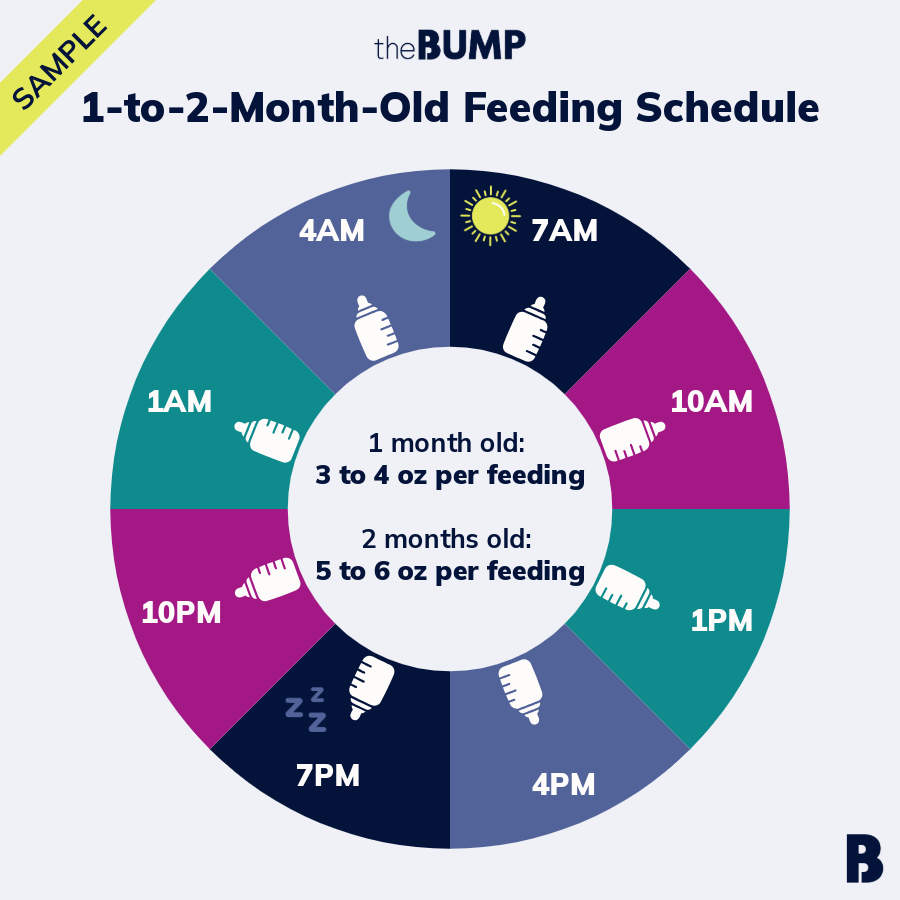
At 1 month old, baby will eat 3 to 4 ounces per feeding, about every three to four hours. By the time they reach 2 months old, the amount goes up to 5 to 6 ounces per feeding, about five to six times per day.
Here’s an example of what your newborn feeding schedule could look like.
3- to 4-month-old schedule
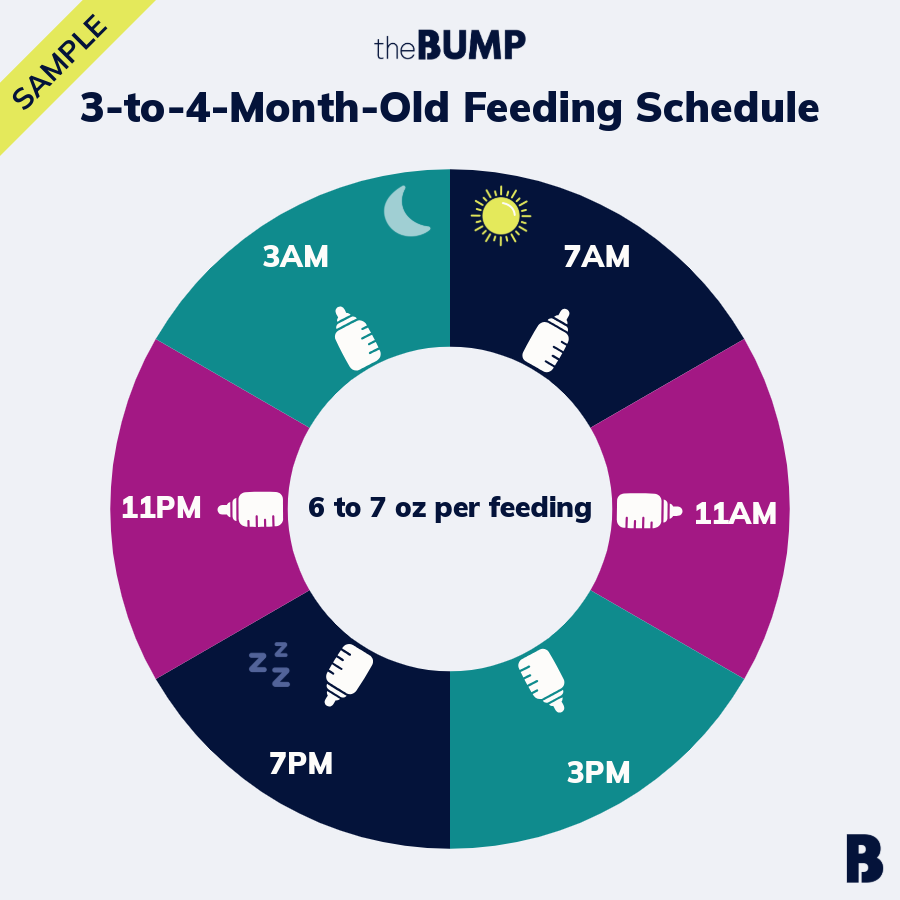
As baby begins to gain weight, they’ll eat more during each feeding session and have fewer overall feeds in a day, according to Dr. Denise Scott, MD, a pediatrician and pediatric endocrinologist in Oklahoma. Between 3 and 4 months, baby will eat between 6 and 7 ounces (possibly up to 8) five to six times per day. Here’s what that might look like:
5- to 6-month-old schedule
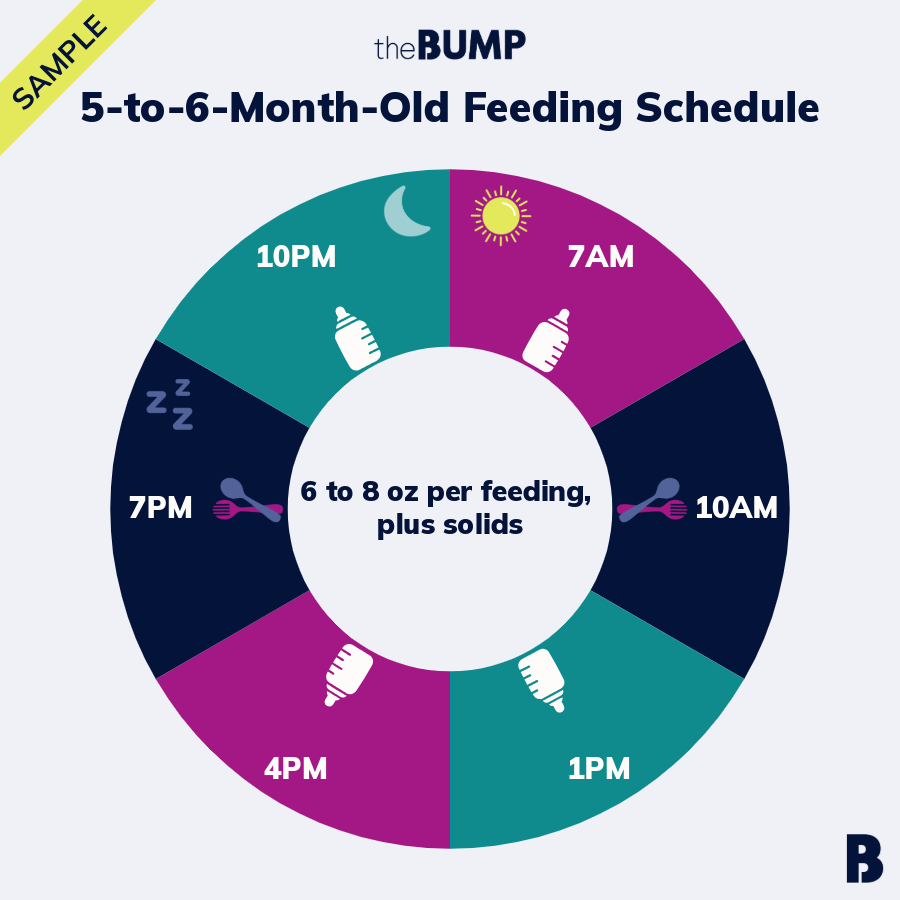
At this point, you’ll likely be introducing solids, but baby will still rely on breast milk or formula as their main source of nutrition. “[Solids] are digested more slowly, so [babies] can sustain themselves longer between feedings,” explains Dr. Scott. In other words, you might be able to drop the nighttime feeds. So how often will a 5- to 6-month-old eat? On average, babies eat two to three solid meals and nurse or bottle-feed up to six times per day. For each feeding, they’ll take in about 6 to 8 ounces. Here’s an example schedule:
It’s important to learn to tell when baby’s signaling they’re hungry and when they’re telling you they’ve had enough. “One time, my daughter just kept drinking her formula, and I figured she was in a growth spurt,” recalls Lori F., a mom of two in Raleigh, North Carolina. “When it came time to burp, she spit up everywhere because, apparently, I let her eat long after she was done.”
So, how do you avoid the dreaded projectile spit-up? By learning their cues. “Sometimes, if a pacifier or anything else is placed in their mouth, a hungry baby will do a rapid, panicked-looking little head shake as they close in on it with their mouth—this suggests they’re actively hungry rather than just wanting to suck on something for comfort,” says Dr. Steelman.
As a lactation consultant, Zaki also notes that a hungry baby may start getting restless, licking their lips, chewing on their hands, rooting or sticking out their tongue. And then there’s the most obvious cue: crying. “Crying is a late feeding cue, and feeding a crying baby can be tricky,” says Zaki. “I usually encourage parents to stay aware, looking for early feeding cues to avoid unnecessary battles with baby.”
When they’re full, Zaki says babies who are fed on demand or pace fed will simply unlatch when they’re full, whether they’re bottle feeding or breastfeeding. Breastfeeding babies may also “switch from active feeding to more passive nursing where they stay latched but are calm and gently sucking,” she explains. Dr. Steelman adds that babies who are done eating often become more sleepy, possibly even falling asleep with the nipple still in their mouth. Another cue is contentment. “If they were crying or fussy before the feed, [and] they seem content now,” then they’re likely satisfied.
Here are some common issues you may run into when feeding a newborn or baby—and how to solve them.
Should you wake a sleeping baby to feed?
Dr. Jennifer Trachtenberg, MD, a pediatrician at Carnegie Hill pediatrics in New York City, tells parents not to wake a sleeping baby once they’ve gained back their birth weight. (It’s normal for newborns to lose weight in the first few days of life and then gain it back.)
Paced bottle feeding for breastfed babies
Paced bottle feeding allows baby to have more control over the feeding process with the use of a slow-flow bottle nipple and strategic breaks. With this method, baby eats more slowly and pauses, rather than guzzling down a full bottle—practically never coming up for air. This teaches them how to pace themselves and stop when they’re full instead of overeating, which leads to discomfort.
Paced bottle feeding is also a good way to help breastfed babies avoid nipple confusion when using a bottle. The slow feeding style mimics feeding from a breast, though you may have to try a few nipples to find the one that works for baby.
Managing growth spurts
During growth spurts, you can expect baby to chow down more since their growth and development is at super speed. Growth spurts happen throughout the first year, from a week after birth to the 12-month mark. You may notice baby’s hungrier than usual or possibly cluster feeding. When this happens, it’s best to feed on demand to ensure baby’s getting what they need for their growth.
Frequently Asked Questions
Is my baby eating too much?
While babies are naturally aware of when they’re hungry and when they’ve had their fill, it’s possible for well-meaning adults to coax baby into overeating, especially from a bottle. To avoid this, watch for signs baby is full, such as turning their head, pushing the bottle away or fussing.
Moreover, don’t be too focused on making sure baby finishes every last drop. Dr. Trachtenberg suggests putting no more than a half-ounce more than you expect baby to eat in a bottle at each feeding. If baby drains that too, you’ll know it’s time to add a little bit more. Either way, go slowly: Try pausing halfway through the bottle, sitting baby up and burping them—then see if they actually want more.
How do I know if my breastfed baby is getting enough milk?
“Unfortunately, there are no empty or full gauges” to determine when baby’s full, says Dr. Steelman. You’ll need to look for cues from baby that signal they’re full and pay attention to the signs coming from your own body. “If Mom has the sensation of fullness before a feed, sees milk leakage from her breast at times and sees milk dribbling from baby’s mouth at times, she can feel sure baby’s getting fed,” she adds. You can also look for signs of contentment from baby. Finally, if your pediatrician tells you that baby’s gaining weight and growing at an appropriate rate, you can rest assured that they’re getting what they need.
What if my baby is a "snacker"?
If baby seems to be snacking, they may be going through a phase of cluster feeding. Cluster feeding often coincides with growth spurts, so if you’re noticing increased feedings (that may be shorter than usual), check to see if they’re in a period where a growth spurt is common. If it’s not cluster feeding, talk to your pediatrician or a lactation consultant to figure out a plan for getting baby on a more regular feeding schedule.
Ultimately, parents want the best for their kids—so, of course, you want to ensure that baby is getting enough to eat. As long as they’re happy, healthy and growing, baby’s feeding schedule is likely just fine. Our baby feeding chart should clear up some confusion too—but if you’re still in doubt about anything, make sure to check in with your pediatrician.
Please note: The Bump and the materials and information it contains are not intended to, and do not constitute, medical or other health advice or diagnosis and should not be used as such. You should always consult with a qualified physician or health professional about your specific circumstances.
Plus, more from The Bump:
Denise Scott, MD, is a pediatrician and pediatric endocrinologist based in Oklahoma with over 30 years of experience. Certified in culinary medicine, Scott is the author of Feed Your Child’s Future Health: Prevent Disease Before It Starts. She received her medical degree from the University of Texas Medical Branch and completed her residency at the University of Oklahoma Health Sciences Center with a fellowship at the National Institutes of Health.
Laura Steelman, MD, is a pediatrician with Bluebird Kids Health in Jacksonville, Florida. She received her medical degree from University of Medicine and Dentistry of New Jersey.
Jennifer Trachtenberg, MD, is a pediatrician with Carnegie Hill Pediatrics in New York City, as well as an assistant clinical professor of pediatrics at the Mount Sinai School of Medicine. She earned her medical degree and completed her residency at the Mount Sinai School of Medicine. She’s also the author of parenting books The Smart Parent’s Guide: Getting Your Kids Through Checkups, Illnesses and Accidents and Good Kids, Bad Habits: The RealAge Guide to Raising Healthy Children.
Jaimie Zaki, LPN, IBCLC, is a lactation consultant, birth doula and founder of Little Bear Lactation in Tuscola, Texas, where mothers who value breastfeeding get the guidance, insight and support they need to thrive postpartum. She’s also host of the Breastfeeding with Confidence podcast.
Mayo Clinic, Feeding Your Newborn: Tips for New Parents, April 2022
Children’s Hospital of Philadelphia, Breastfeeding Tips for Beginners
Healthy Children (American Academy of Pediatrics), How Often and How Much Should Your Baby Eat?, July 2021
Cleveland Clinic, Colostrum, February 2022
Nutrition in Clinical Practice, Importance of Human Milk for Infants in the Clinical Setting: Updates and Mechanistic Links, October 2023
American Academy of Pediatrics, Newborn and Infant Nutrition, 2023
March of Dimes, Feeding Your Baby Formula, April 2019
Healthy Children (American Academy of Pediatrics), Pacifiers: Satisfying Your Baby’s Needs, December 2012
Cleveland Clinic, Feeding Your Baby: The First Year, September 2023
Mount Sinai, Breastfeeding vs. Formula Feeding, April 2023
Centers for Disease Control and Prevention, How Much and How Often to Feed, April 2022
Academy of Nutrition and Dietetics, Do’s and Don’ts for Baby’s First Foods, March 2021
National Health Service UK, Breastfeeding: Is My Baby Getting Enough Milk?, September 2022
La Leche League, (laleche.org.uk), Sleepy Baby - Why and What to Do, June 2022
Nationwide Children’s, Newborn Warning Signs, October 2023
Johns Hopkins Medicine, Feeding Guide for the First Year, July 2019
Healthy Children (American Academy of Pediatrics), How to Read a Growth Chart: Percentiles Explained, September 2015
US Department of Agriculture, WIC Breastfeeding Support, The Phases of Breast Milk
Minnesota Department of Health, Paced Bottle Feeding: Infant Feeding Series, 2017
Cleveland Clinic, 4 Myths About Nipple Confusion, How to Avoid It and When to Get Help, September 2024
Real-parent perspectives:
- Katie G., mom of two in Indianapolis
- Lori F., mom of two in Raleigh, North Carolina
Contributing writer: Natalie Gingerich Mackenzie
Learn how we ensure accuracy of our content through our editorial and medical review process.
Target Baby Registry
Free $100+ Value Welcome KitFree $100+ Value Welcome Kit
15% Completion Discount15% Completion Discount
Free 1-Year ReturnsFree 1-Year Returns
20+ Exclusive 20% Off
Deals For Mom & Baby20+ Exclusive 20% Off Deals For Mom & Baby1:1 Concierge With
Baby Gear Specialists1:1 Concierge With Baby Gear Specialists

*Subject to availability and Retailer's terms.
We earn commissions from these links.