





















What to Know Before Piercing Baby’s Ears

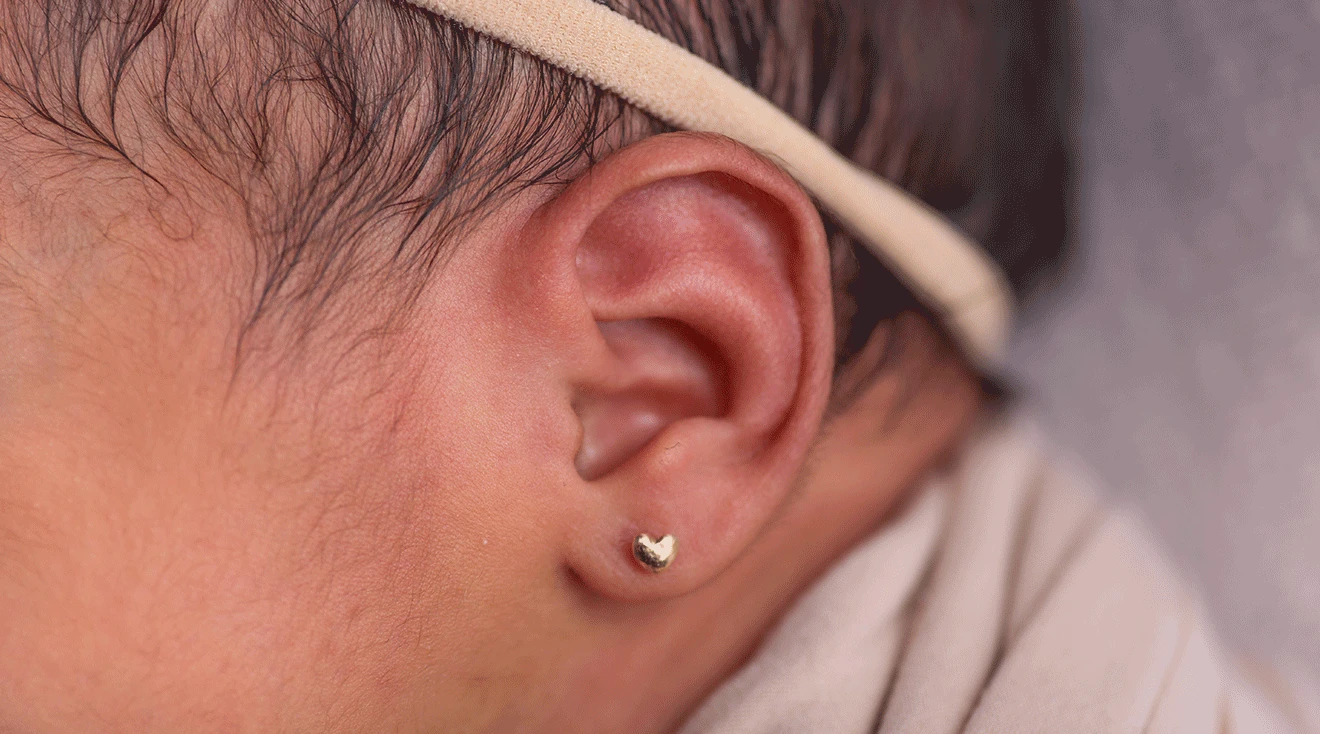

At some point in time, you’ll come across a very cute sight: a happy baby with their tiny ears pierced. It’s relatively common for parents to pierce their little one’s ears, and, in some cases, the practice isn’t cosmetic at all—it’s significant to the family’s culture. That said, if you’ve had any piercings done before, you know it can be painful, and that after-care is essential to healthy healing and infection prevention. So if you’re considering piercing baby’s ears, it’s important to educate yourself about the dos and don’ts. Here, experts offer a few things to keep top of mind.
Getting baby’s ears pierced is relatively safe, as long as the piercing is performed carefully and cared for properly, notes the American Academy of Pediatrics (AAP). Lyndsey Garbi, MD, a board-certified pediatrician and neonatologist at Blueberry Pediatrics in Mountain View, California, says that a critical early step is finding a professional who knows how to safely do infant ear piercings.
Jenelle Ferry, MD, a board-certified pediatrician and neonatologist at Pediatrix Medical Group in Florida, says you should ask the following questions when choosing a place have your infant’s ears pierced. These include:
- Are the tools and equipment properly sterilized? How?
- How much experience do you have performing ear piercings? Do you have experience with babies?
- What types of earrings are used for the piercing?
- Do you have any age requirements?
The AAP recommends piercing baby’s ears with round, gold post earrings, as gold is best for avoiding allergic reactions and inflammation. Ferry specifically recommends 14-karat or higher gold; surgical steel or titanium are other safe, hypoallergenic metals.
Eager to pierce baby’s ears sooner than later? Both Garbi and Ferry recommend waiting until they’re at least 3 months old. “Infections in babies when they’re younger than 3 months are very dangerous,” Garbi says. “Many require a lot of tests, antibiotics and hospital admissions.” However, by 3 months, baby has had some vaccinations and built up a stronger immune system. Plus, “a fever is less concerning and doesn’t require hospitalization,” Ferry adds.
While the AAP notes that it’s safe to pierce an infant’s ears, they suggest waiting until a child is old enough to take care of the piercing sites themselves. (More on this below.) “From my personal experience with my daughter, who pierced her ears at 4 years old by choice, the actual piercing was just the beginning,” Garbi says. “Cleaning the area was very difficult because it scared her. No matter how well we cleaned it, they still got infected and required medical treatment.”
Piercing providers may also have their own minimum age requirements. Depending on the state you live in, you may need to sign a parental consent form.
It’s generally considered safe to have baby’s ears pierced, but it’s not entirely risk free. Even if you go to a reputable piercer who uses properly sterilized tools, there are complications that can arise during the healing process.
Garbi says the biggest risk when it comes to infant ear piercings is infection. “You must be prepared to partake in the aftercare of the piercings to avoid [a bacterial infection],” she explains. Baby could also experience an allergic reaction, especially if the earring posts are made from a material like nickel.
There’s also a risk of the earrings coming loose or getting pulled out (particularly if baby is extra grabby), and that it could also become a choking hazard. “For infants and toddlers, earrings with locking or screw-on backs can be more secure and reduce the risk of the object coming loose from the ear and potentially getting into the airway,” says Ferry.
You typically have a few options: a pediatrician’s office, an ENT’s office (ear, nose and throat doctor), a piercing studio or a jewelry store. Of course, not every pediatrician offers this service, so you’ll need to check with your provider. (FYI, even if you are able to get baby’s ears pierced at the pediatrician’s office, it’s considered a cosmetic procedure, so be prepared to pay out of pocket.)
Infant ear piercings are typically done manually with a needle or with a piercing gun, explains Garbi. “Each piercer may have a preferred method of piercing,” she adds. There may also be a difference in how your child’s pediatrician pierces ears versus how a professional piercer or jeweler does it.” In short, you’ll want to ask which technique they’re planning to use.
When piercing a baby’s ears by hand, Ferry says the ideal procedure either involves individually sealed and disposable ear piercers or a sterile needle. “Spring-loaded ear piercing instruments may lead to more tissue trauma, which can increase the risk of embedded earrings, scarring or keloid formation [i.e. raised scar tissue],” she says. Additionally, ear-piercing guns can be more difficult to sterilize, resulting in a higher risk of infection, Ferry adds.
Wondering if you can use a numbing cream for piercing baby’s ears prior to their appointment? Per Mayo Clinic, experts caution against using creams like lidocaine on newborns and young infants, as it can have some negative side effects. Always confer with your pediatrician before using any kind of numbing cream on baby.
There’s no getting around the fact that your little one’s ears will be sore for a few days after getting their ears pierced. Ferry says that, fortunately, this pain is “usually short-lived.” To help keep your baby as comfortable as possible, Garbi suggests using caution when putting on or removing clothing to avoid grazing the area. Additionally, she suggests keeping hair away from the area to keep it from getting stuck.
Depending on your little one’s age, you may also be able to give them Tylenol or Motrin to help manage any discomfort. (Just be sure to confirm dosage with your pediatrician before administering any medication.)
Whoever you choose to pierce baby’s ears, they should provide you with care instructions at the end of your appointment—and it’s important to follow them closely to encourage healing and mitigate infection risk.
The AAP recommends applying rubbing alcohol or an antibiotic ointment to the piercing site two times a day following the piercing, taking care to tend to the front and back of each lobe. You’ll want to keep the earrings in place for six weeks and gently rotate them daily. (Be sure to wash your hands with soap and warm water before touching baby’s ears.) Finally, ask your pediatrician if baby should avoid pools or other bodies of water while the piercings are healing.
During the healing process, it’s important to keep an eye out for signs of infection. “If there’s persistent pain, redness or swelling, a pediatrician should check [ baby’s ears] to determine if there’s an infection,” says Garbi. If baby’s ears are infected, they may need antibiotics.
If you want to pierce baby’s ears, rest assured that it can be done safely. The most important thing to prioritize is finding a professional piercer (or pediatrician) who properly sterilizes their tools. Then, stay on top of care to see the healing process through.
Please note: The Bump and the materials and information it contains are not intended to, and do not constitute, medical or other health advice or diagnosis and should not be used as such. You should always consult with a qualified physician or health professional about your specific circumstances.
Jenelle Ferry, MD, is a board-certified neonatologist and pediatrician practicing at Pediatrix Medical Group in Florida. She received her medical degree from the University of Oklahoma School of Medicine in 2005.
Lyndsey Garbi, MD, is a board-certified pediatrician, neonatologist and the co-founder and chief medical officer of Blueberry Pediatrics in Mountain View, California. She received her medical degree from the Sackler School of Medicine in New York City.
American Academy of Pediatrics, Avoiding Infection After Ear Piercing, June 2023
Riley Children’s Hospital, Ear Piercing For Kids: Safety Tips From a Pediatrician, November 2023
Association of Professional Piercers, Issues With Piercing Guns
Mayo Clinic, Lidocaine And Prilocaine (Topical Application Route), June 2024
Children’s Minnesota, Anesthetic (Numbing) Cream
Learn how we ensure the accuracy of our content through our editorial and medical review process.
Target Baby Registry
Free $100+ Value Welcome KitFree $100+ Value Welcome Kit
15% Completion Discount15% Completion Discount
Free 1-Year ReturnsFree 1-Year Returns
20+ Exclusive 20% Off
Deals For Mom & Baby20+ Exclusive 20% Off Deals For Mom & Baby1:1 Concierge With
Baby Gear Specialists1:1 Concierge With Baby Gear Specialists

*Subject to availability and Retailer's terms.
We earn commissions from these links.