







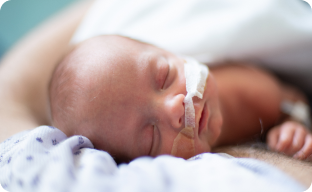


What Happens in the Newborn Hospital Nursery?


The movies tell us that a baby nursery is a place where newborns lie in their respective cubbies crying it out until a family member visits, points at a given child and asks a nurse for some snuggle time. Reality check—this isn’t how it actually works.
In real life, a baby nursery is where babies undergo early tests and screenings; it’s also a place where they can sleep for a bit while new parents try to grab some much-needed rest of their own. Laura T., a mom of two in California, says she used the hospital nursery with both of her babies for that very reason. “The night nursery made a world of difference in allowing me to get a little extra sleep those first days after birth,” she says. And while she was hesitant to leave her newborns, she knew they were under the care of nurses and staff who are incredibly experienced.
Hospital nurseries are slightly different everywhere, but there are a few commonalities, and it’s helpful to have some baseline knowledge to know if this is a feature you’ll even want to take advantage of. Here, the facts straight from healthcare providers who work with newborns.
- The newborn hospital nursery is a dedicated area where healthy babies can spend time after birth. It’s usually reserved for any testing baby may need. Babies sometimes also spend time in the nursery so Mom can sleep and recover.
- While families generally can’t go into the hospital nursery, parents can check in on their newborn at any time.
- The hospital nursery is different from the neonative intensive care unit (NICU) in the level of care it provides. Hospital nurseries are usually at a level one, which is reserved for healthy babies. NICUs can go up to level four, which is reserved for newborns and preemies that need critical medical attention.
As noted, a hospital nursery serves as a dedicated safe space for babies, but every hospital facility is slightly different. When people talk about a hospital nursery, they’re usually referring to a level one nursery, also called a “well baby nursery,” for newborns born at full-term (i.e. 35 weeks or later), says Rebecca Fisk, MD, pediatric hospitalist at Northwell’s Lenox Hill Hospital. Levels beyond that are typically referred to as the NICU (neonatal intensive care unit).
Per the American Academy of Pediatrics (AAP), neonatal care can be broken down into four levels. The first level is usually applicable to hospital nurseries for full-term newborns, while the rest (levels two through four) are for premature infants or babies “needing specialized or intensive medical care such as breathing problems, infections or other medical concerns,” adds Denise Castellanos, CNM, lead midwife at MemorialCare Saddleback Medical Center’s Women’s Health Pavilion in Laguna Hills, California.
Again, it often depends on the hospital. Usually, the hospital nursery will have several doctors that come through, including pediatric hospitalists (pediatricians that specialize in hospital care and medicine for kids), pediatric residents and pediatricians who work in the community, notes Joanna J. Parga-Belinkie, MD, an attending neonatologist in the Division of Neonatology at Children’s Hospital of Philadelphia. Baby nurseries will also typically have registered nurses who specialize in newborn care, nursing assistants (to do things like help change diapers and swaddle babies); lactation consultants; midwives and ward clerks, who handle administrative duties for the nursery, Castellanos says.
These medical staffers will typically all have access to baby in the hospital nursery. Rest assured that other people can’t just walk into the nursery and interact with the babies. “Most hospitals don’t let parents into the nursery,” Fisk explains. “The parents can pick up the baby at the nursery or drop off baby, but they don’t go into it.”
It depends on what baby’s there for. “Generally speaking, babies don’t go to the nursery on a regular basis,” says Jeffrey Shenberger, MD, the division head of neonatology at Connecticut Children’s. “Most of the time, baby is with the mother.” But babies may go to the nursery for a blood draw or other newborn screenings, like hearing tests, pediatric exams or circumcisions (if requested), Castellanos says.
Baby may also go to the nursery when new parents need some sleep. “A lot of times it can be used because the family needs to rest after the delivery,” Parga-Belinkie says. “Maybe it was a very long labor and Mom didn’t get to sleep for days and needs a three-hour nap.”
The biggest benefit of the well baby hospital nursery is the opportunity for rest it affords new parents, whether that’s a nap or a shower, Shenberger says. “That’s truly a big benefit for some families,” Parga-Belinkie adds. It also provides a place for baby to be briefly monitored or tested. For example, if parents are concerned about a small choking episode in their full-term newborn, they may go to the hospital nursery vs. the NICU, she adds. But, aside from routine screenings or monitoring, most of baby’s intensive care will take place in a NICU, so the hospital nursery is really a benefit for parents looking for a reprieve. “I know something like this is a personal choice but my experience with using the hospital nursery was wonderful,” shares Tomeko B., a mom in North Carolina. “The nursery provided the time I needed to rest after giving birth, but also gave me a balance of bonding time and feedings.”
You can keep baby with you if that’s your preference—the practice is usually called rooming in, and it’s become much more common (and encouraged!) at hospitals, Parga-Belinkie says. “Most hospitals are going toward a model where birth parents and baby aren’t separated,” she adds.
There are some benefits to keeping baby with you. It can be helpful for early breastfeeding, as you learn baby’s feeding cues, and it can foster an early bond between parent and child, with opportunities for skin to skin contact, Fisk says.
“You can get your first couple days of bonding and newborn care right there,” Shenberger adds. “The nurses can watch the interaction. If there are troubles with beginning feeding or nursing, the nurses can give counseling in real-time.”
Frequently Asked Questions
What’s the difference between a hospital nursery and NICU?
The main difference between a hospital nursery and NICU is the level of care. NICUs are generally designed for babies that need more intensive care, Shenberger says. Babies in the NICU will usually have continuous monitoring of their heart rate and other vital signs. “There’s a lot more hands-on oversight of baby in the NICU,” Shenberger explains. The nursery, by comparison, is centered around full-term, healthy infants.
How long do babies stay in the hospital nursery?
It depends. Typically, baby may be there anywhere from a few minutes for testing to several hours, Fisk says. “It’s a very good place for when we have to evaluate babies and also for moms and dads to get two to four hours of rest,” she says.
Do all hospitals have baby nurseries?
No, not all hospitals have baby nurseries. “The primary reason is because they’ve been under-utilized. If you have one, you have to staff it,” Shenberger says. Most hospitals have instead transitioned to focusing on baby rooming-in with the parents.
What is the difference between nursery and rooming-in?
“The nursery is where the hospital staff professionals provide care for the babies,” Castellanos says. “Rooming-in is when the newborn baby stays in the parents’ room and Mom initiates care with the assistance of the registered nurse or other professional medical staff. This allows the baby to stay with the parents, and the staff does the appropriate procedures in the room.”
Hospital nurseries can benefit new parents who need a bit of a rest as they transition to this next chapter in parenthood. But not every facility offers a hospital nursery for new parents. If this is a feature you’re interested in, it’s a good idea to check with your medical center in advance. They can help provide more details about what you can expect once baby arrives.
Please note: The Bump and the materials and information it contains are not intended to, and do not constitute, medical or other health advice or diagnosis and should not be used as such. You should always consult with a qualified physician or health professional about your specific circumstances.
Plus, more from The Bump:
Jeffrey Shenberger, MD, is the division head of neonatology at Connecticut Children's. He earned his medical degree from Pennsylvania State University College of Medicine and completed his residency at University Of Minnesota.
Rebecca Fisk, MD, is the pediatric hospitalist at Northwell’s Lenox Hill Hospital. She earned her medical degree from City University of New York and completed her residency at Massachusetts General Hospital.
Joanna J. Parga-Belinkie, MD, is an attending neonatologist in the Division of Neonatology at Children's Hospital of Philadelphia. She earned her medical degree from Mount Sinai School of Medicine and completed her residency at Children's Hospital Los Angeles.
Denise Castellanos, CNM, is the lead certified nurse-midwife at MemorialCare Saddleback Medical Center’s Women’s Health Pavilion in Laguna Hills, CA. She earned her medical degree at California State University Los Angeles.
American Academy of Pediatrics, Standards for Levels of Neonatal Care: II, III, and IV, May 2023
Learn how we ensure the accuracy of our content through our editorial and medical review process.
Target Baby Registry
Free $100+ Value Welcome KitFree $100+ Value Welcome Kit
15% Completion Discount15% Completion Discount
Free 1-Year ReturnsFree 1-Year Returns
20+ Exclusive 20% Off
Deals For Mom & Baby20+ Exclusive 20% Off Deals For Mom & Baby1:1 Concierge With
Baby Gear Specialists1:1 Concierge With Baby Gear Specialists

*Subject to availability and Retailer's terms.
We earn commissions from these links.


